

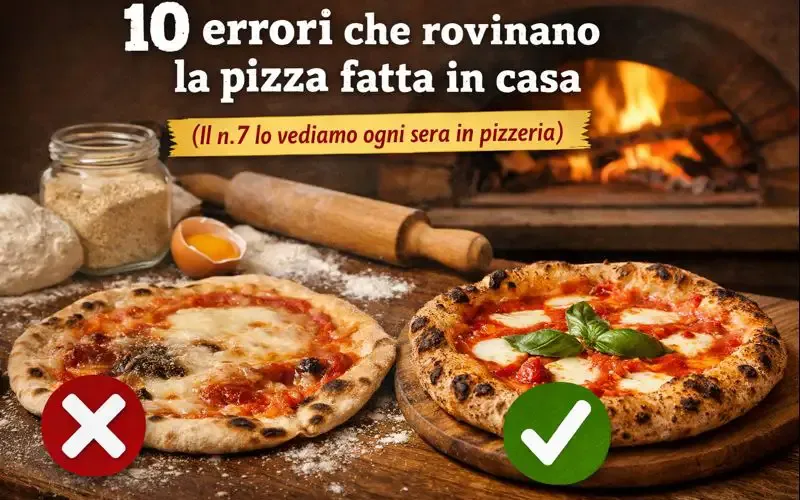
10 Mistakes That Ruin Homemade Pizza
Making pizza at home is one of life’s great pleasures: mixing the dough, stretching it out, that amazing smell in the kitchen… and then you pull it from the oven and it’s still a bit raw in the middle, too hard like flatbread, or with no crust at all.
Don’t worry — it happens to almost everyone.
In this article, we’ll look at the 10 most common mistakes that can ruin homemade pizza, and how to avoid them. We’re not promising magic, but if you fix these, your next pizza will be much closer to a true Neapolitan style… and when you want to taste the perfect result — the one baked in a wood-fired oven — you already know where to find us. 😉
1. Using the wrong flour
“I used whatever flour I had in the cupboard.”
That’s the first classic mistake.
For Neapolitan-style pizza, not all flours are suitable:
-
you need a flour with the right strength (enough protein)
-
it must handle a medium-to-long fermentation
-
flours that are too weak give you a soft dough that tears easily and won’t hold its shape
It’s better to choose a good 0 or 00 flour made specifically for pizza, not an “all-purpose” flour. The right flour helps you develop that classic puffy, soft crust — not a hard, biscuit-like edge.
2. Using too much yeast “to make it rise more”
Another very common mistake: doubling (or even tripling) the yeast to speed things up.
The result? A pizza that’s:
-
heavy
-
hard to digest
-
with an overly strong yeast flavour
The secret isn’t “more yeast” — it’s more time.
Use less yeast and let the dough do its work slowly. That’s what we do in the pizzeria: long fermentation, little yeast, and plenty of patience. You can taste the difference from the very first bite.
3. Ignoring fermentation and maturation times
Even with the right flour, if you don’t give the dough time to:
-
ferment
-
mature (letting the enzymes work inside the dough)
you’ll end up with a pizza that puffs up in the oven… but then sits heavy in your stomach.
A good dough needs:
-
a first bulk fermentation
-
then a second phase after dividing (when you shape the dough balls)
-
the right temperatures (not too warm, not too cold)
It’s not just about volume — it’s about digestibility.
4. Rolling the dough with a rolling pin
We know: it’s easy, it’s quick, everyone has one at home.
But for Neapolitan-style pizza, the rolling pin is a declared enemy.
When you roll the dough:
-
you squash out the air developed during fermentation
-
you flatten the crust
-
you get an even, thin disc — closer to low focaccia than a real pizza
Stretching should be done only with your hands, pushing the air from the centre towards the edges. That’s how you create the puffy, airy crust you see in pizzeria photos.
5. Overloading it with toppings and cheese
“The more I put on top, the better it will be.”
Unfortunately, no.
Loading your pizza with:
-
too many cheeses
-
cured meats everywhere
-
watery vegetables
-
extra sauces
creates a heavy surface that releases moisture — and often the base stays undercooked or soggy.
True Neapolitan pizza is all about balance: good tomato, good mozzarella, a few well-chosen ingredients, and that’s it. Better a few high-quality products than a “clean-out-the-fridge” pizza.
6. Using ingredients straight from the fridge
Another mistake you can’t see, but you can taste:
-
mozzarella just taken from the fridge
-
cold sauce
-
working the dough while it’s still very cold
Temperature shocks affect both the dough and the bake. Cold mozzarella, in particular, releases even more water in the oven and can create a “lake” in the centre of the pizza.
Better to:
-
take ingredients out in advance
-
let them come to room temperature
-
cut and drain mozzarella well, especially if it’s very moist
7. Trusting random internet recipes blindly
This is one of the mistakes we see most often: following a recipe you found in a hurry, without understanding what’s behind it. Doughs with:
-
unrealistic hydration levels
-
impossible timings (“ready in 30 minutes!”)
-
temperatures that aren’t explained
A good pizza recipe should talk about:
-
the water-to-flour ratio
-
the type of yeast
-
fermentation times and stages
-
fridge and room temperatures
If these details are missing, you’re basically baking blind. Use recipes as a starting point to adapt — not as absolute truth.
8. Underestimating your home oven
Ok, you don’t have a wood-fired oven in your living room (thankfully 😄).
But many people use their home oven at only half its potential:
-
temperature too low (200–220°C isn’t enough)
-
not preheating long enough
-
no pizza stone or preheated tray/steel
To get closer to a good pizza:
-
set the oven to the highest temperature possible
-
preheat for at least 30–40 minutes
-
if you can, use a pizza stone or a tray left inside to heat up properly
True Neapolitan pizza bakes in just a few minutes thanks to very high heat. At home we can’t reach those temperatures, but we can recreate the conditions as much as possible.
9. Baking the dough before it’s ready
It happens a lot: the dough “has risen a bit”, we’re in a hurry, and into the oven it goes.
Signs the dough isn’t ready:
-
the dough ball is too firm and hard to stretch
-
no bubbles on the surface
-
the crust doesn’t puff up while baking
-
the dough tears easily
A ready dough ball, on the other hand, is:
-
soft but not sticky
-
full of small bubbles
-
elastic and easy to stretch without tearing
Sometimes waiting just one more hour makes a huge difference.
10. Forgetting that pizza is about sharing
The last mistake — but no less important: focusing only on technique and forgetting the pleasure.
Pizza isn’t just:
-
flour, water, yeast, and an oven
It’s also:
-
friends, family, chatting, laughter, and a little kitchen chaos
When you feel like making dough, it’s wonderful to challenge yourself and improve. But when the day is long, the fridge is empty, and you’re low on energy… sometimes the real luxury is sitting down and being looked after by people who make pizza every day.
And when you just want to eat the “perfect” pizza?
If you put these tips into practice, your homemade pizza will already be much better than average.
But if one evening you simply want to sit down and order a true wood-fired Neapolitan pizza, with a high, airy crust and carefully selected ingredients, you can always come and see us at the Neapolitan pizzeria ‘A Tarantella in Milan.
Whether you’re a home pizza maker or you just love pizza made by someone else, one rule always stays the same:
pizza is meant to be shared. And if you’d like to enjoy it with us, we’re waiting for you at www.pizzeriaatarantella.it.