

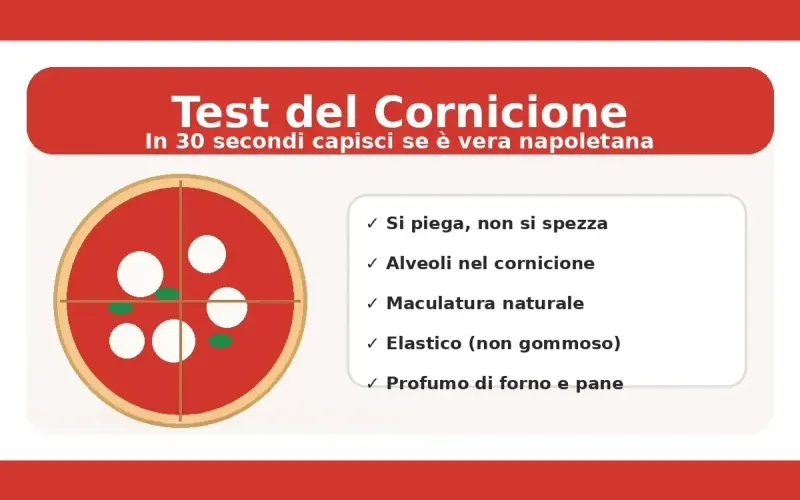
The Cornicione Test: How to Spot Real Neapolitan Pizza
The cornicione test: in 30 seconds you’ll know if it’s real Neapolitan pizza (and where to try it in Milan)
You know that moment: you order a “Neapolitan-style” pizza, it arrives looking gorgeous… and then the first bite tells you something’s off.
Too dry. Too crunchy. Too “biscuit-like”.
Or yes, it’s soft… but rubbery, with no aroma, no lightness — nothing that makes you think: ok, this is the real deal.
Good news: you don’t need to be a pizzaiolo to figure it out. You just need a super quick test — 30 seconds, no tools — using only your eyes and hands, by checking the cornicione (the raised edge).
It’s the simplest way to tell the difference between a pizza that’s merely “Napoli-inspired” and a proper Neapolitan pizza.
And at the end, I’ll tell you where you can do this test in real life in Milan (spoiler: Lambrate area).
Actually, I’ll tell you now — and I’ll repeat it below: real Neapolitan pizza in Milan exists.
The 30-Second Cornicione Test (no tools — just eyes and hands)
1) The fold rule
Pick up a slice and gently fold it.
-
If it snaps like a cracker: it’s not Neapolitan (or it’s been baked/handled in a way that made it turn into something else).
-
If it stays soft without collapsing like a wet cloth: you’re on the right track.
Real Neapolitan pizza is flexible, not stiff. And it should never crunch like Roman pizza (which is great too — just a different style).
2) The air pockets: the “cloud” inside the edge
Look at the cornicione from the side. Do you see irregular bubbles and small pockets of air — a soft, airy structure?
That’s a strong sign of a well-made dough, properly fermented and matured — one that won’t turn into a brick as soon as it cools down.
If the edge is compact and uniform, like industrial bread… you’ve probably just met a Neapolitan look-alike.
3) The spotting: the right “freckles”
Neapolitan cornicione often has darker spots — not burnt black patches, but natural leopard spotting.
-
If it’s pale and flat: the oven temperature or heat management wasn’t right.
-
If it’s aggressively black: overbaked (often bitter).
The right spotting is a clue: it means the pizza hit a properly hot oven with a fast bake — without turning into ash.
4) The touch test: soft outside, “dry” inside
This one is easy: gently press the cornicione.
It should feel soft, elastic, and spring back.
It should not:
-
release moisture like a sponge
-
feel sticky on your fingers
-
stay flattened after you press it
The difference is here: a great cornicione is fluffy but not wet, light but not empty.
5) The smell: if it doesn’t smell like bread, something’s wrong
Bring the slice close and smell it.
It should smell of dough — bread, oven heat, grain — and then the toppings.
If all you smell is “toppings” and the edge is neutral, it often means the dough was treated as a support — not as half of the experience.
If it passes the test… why do some pizzas still feel heavy?
Because the cornicione is your first filter — but behind it are details you can’t see immediately:
-
dough management (hydration, mixing, timing)
-
baking and resting time
-
quality and quantity of ingredients
-
balance between base and toppings
You can have a pizza that looks great and is technically “correct”… but if it’s unbalanced, it can still feel heavy.
A proper Neapolitan pizza should make you want another bite, not a sofa.
The final test (worth more than a thousand posts): try it in real life
Next time you’re at a pizzeria, don’t start with “I like it / I don’t like it”. Start with the test.
And if you want to do it in Milan, you can try it at Pizzeria ’A Tarantella (Lambrate area). It’s a fun way to turn dinner into a real experience — because you’ll notice the details from the first look and the first bite.
👉 Want to do the cornicione test live? Visit: Pizzeria ’A Tarantella – Home (menu, booking, info).
Mini checklist to save (yes — really 30 seconds)
✅ the slice folds, it doesn’t snap
✅ cornicione with irregular air pockets
✅ natural spotting (not pale, not burnt)
✅ elastic to the touch, not wet or rubbery
✅ smells like bread/oven + ingredients
If you get 4 out of 5, you’re usually in very good hands.
Where it is and when to go (if you want to do it “now”)
To plan quickly: Via Guido Mazzali 5, 20132 Milan.
Hours: 12:15–14:45 and 19:15–23:00 (daily).
Phone: +39 02 2851 0895.