

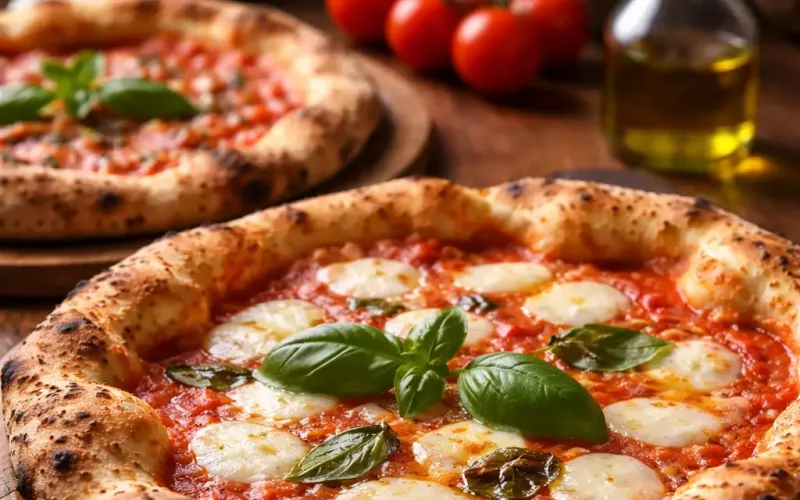
8 False Myths About Neapolitan Pizza
Here are 8 false myths about Neapolitan pizza people have always told you (and #5 starts arguments every time)!
Let’s be honest: when it comes to Neapolitan pizza, you hear more urban legends than genuinely helpful advice. And it’s not just about “general knowledge” — if you believe certain myths, you end up choosing the wrong thing, ordering at random, and then deciding “I don’t like Neapolitan pizza.”
Spoiler: very often it wasn’t Neapolitan (or it wasn’t made properly), or someone sold you a “rule” that isn’t a rule at all.
Below you’ll find 8 myths that are everywhere, explained simply — so next time you’ll understand what you’re eating (and what to order to truly enjoy it).
And yes: myth #5 is the one that sparks the hottest debates at the table.
Myth #1: “If it isn’t crispy, it’s undercooked”
No. Classic Neapolitan pizza is built around a precise idea: soft in the centre, with a tender, airy crust and a slice that folds. If you’re expecting that loud crunch, you’re looking for a different style (Roman-style, pizza al taglio, tray pizza, and so on).
The right questions aren’t “is it crispy?” but:
-
is it baked evenly?
-
is the centre soft but not gummy?
-
is the crust elastic and fragrant?
If you judge it only by crispiness, you might reject a well-made Neapolitan pizza just because it doesn’t “make noise.”
Myth #2: “A high crust = quality”
A tall crust looks impressive — true. But on its own, it means nothing.
A crust can be huge and still be:
-
hollow like a balloon (lots of air, little structure)
-
rubbery and damp
-
heavy, because the dough was handled or fermented poorly
A good crust isn’t “tall”: it’s balanced. It should be soft, with irregular air pockets, and natural leoparding (those little dark “freckles” that come from a well-managed oven). If it’s tall and balanced, great — but don’t get hypnotised by height alone.
Myth #3: “The more toppings, the better the pizza”
This myth ruins more pizzas than it saves.
Neapolitan pizza lives on balance: dough + tomato + dairy + topping. When you pile half the fridge on top, you often get:
-
a centre that’s too wet
-
flavours fighting each other
-
a pizza that feels “too much” after two slices
If you want to judge a pizzaiolo’s skill (and understand if a place is really good), do something simple: start with a Margherita or a Marinara. Those are the pizzas that reveal everything.
Myth #4: “Real Neapolitan pizza must be ‘soupy’ in the middle”
Let’s be honest: a bit of softness in the centre is normal. But “soupy” isn’t a rule — it’s often a sign something is out of balance, such as:
-
too much sauce/topping
-
mozzarella management
-
baking
-
resting/serving time (even the minutes between oven and table matter)
A proper Neapolitan pizza is juicy, not watery. The bite should feel full — not like you need a spoon.
Myth #5 (the one that starts arguments): “Buffalo mozzarella is always better”
Here we go. Tables divided, friendships tested, family group chats on fire.
The truth: it depends (yes, I know — not a clickbait answer, but it’s the right one).
Buffalo mozzarella has specific traits: it’s moister, saltier, and more intensely milky. It can be fantastic… but it isn’t automatically “superior” on every pizza.
When does buffalo mozzarella work beautifully?
-
when the dough can handle the extra moisture
-
when it’s used in the right amount
-
when it’s handled properly (often placed differently than fior di latte)
When can it make the pizza worse?
-
if it floods the centre
-
if it covers everything and makes flavours one-note
-
if it leaves you feeling “heavy” — and you end up blaming Neapolitan pizza in general
Bottom line: buffalo mozzarella and fior di latte are tools, not medals. The best pizza is the balanced one — not the one with the most “prestigious” label.
Myth #6: “If there are dark spots on the crust, it’s burnt”
Another classic. Dark spots (leoparding) are often a sign of high-temperature baking done well — typical of Neapolitan pizza. They don’t automatically mean bitter or burnt.
Of course, if it’s charcoal-black and tastes smoky, that’s a problem. But those “freckles” on the crust are often a clue the oven did its job properly (high heat and a fast bake). And speaking of that: even on this blog we talk about very high temperatures for wood-fired baking.
Myth #7: “Marinara is a ‘poor’ pizza, so it’s less interesting”
If you think that, you’re missing one of the smartest pizzas ever invented.
Marinara is minimalist: few ingredients, zero excuses. That’s exactly why it’s the perfect test:
-
if the tomato is good, you’ll taste it
-
if the olive oil is high quality, you’ll taste it
-
if the dough is fragrant, you’ll taste it
And it’s a pizza that can surprise you with regional variations and interpretations (without losing its identity). It’s no coincidence that ‘A Tarantella’s recipe section talks about Marinara variations and interpretations.
Myth #8: “If it feels heavy, it’s ‘Neapolitan pizza’s fault’”
Often it’s the opposite: when Neapolitan pizza is made well and balanced properly, the usual feeling is “I could actually eat another slice.”
If it feels heavy, there can be many reasons (and they’re not always your fault):
-
dough not fermented/matured properly
-
toppings too heavy or unbalanced
-
uneven baking
-
mozzarella too wet or handled poorly
As a customer, what you can do is simple: pick “test” pizzas (Margherita/Marinara) and judge the balance. Everything else follows.
If you want to be sure in Milan: try the “no-myths” test
If you’d like to turn this list into something practical, here’s an idea: go out for pizza and make a mini game with the people you’re with.
-
order a Margherita (or a Marinara)
-
look at the crust, the centre, the aroma
-
then move on to a richer pizza and see if the balance still holds
If you want to do it in a place that brings a true Neapolitan atmosphere to Milan (Lambrate area, Via Guido Mazzali 5), you can try it at Pizzeria ‘A Tarantella.
👉 You’ll find everything here (menu, info, contacts): Pizzeria Napoletana ‘A Tarantella.
Bonus (useful if you’re having lunch on a weekday)
If you care about the practical details: the Contacts page states they accept meal vouchers, with some conditions (for example, weekday lunches).